⚡ Key Takeaways
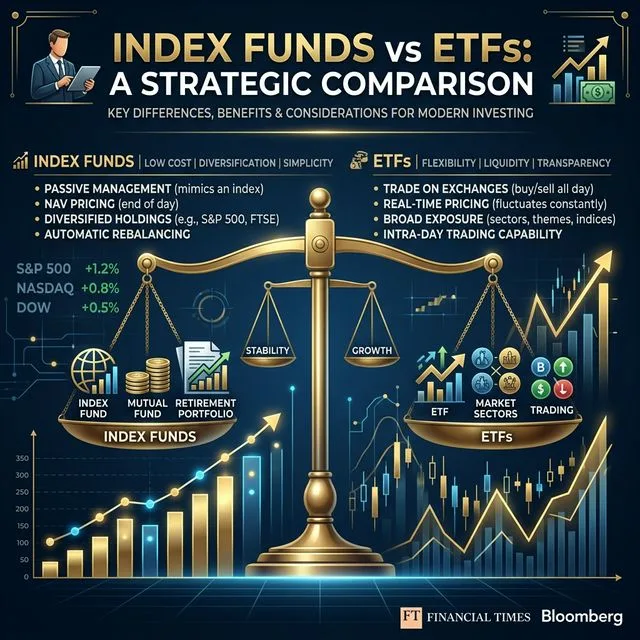
- Both index funds and ETFs track the same underlying indexes — the differences are mostly about how you buy them
- ETFs trade like stocks (during market hours); index funds trade once per day at closing price
- ETFs often have lower minimums; some index funds require $1,000–$3,000 to start
- Neither is universally "better" — for most investors, the best choice is simply to pick one and start
Walk into any investing forum and you'll hear people argue passionately about index funds versus ETFs. The irony? For most investors, the difference is almost irrelevant. Both are brilliant vehicles for building long-term wealth. Here's what actually matters.
What Is an Index Fund?
An index fund is a mutual fund that passively tracks a market index — like the S&P 500 or the total US stock market. Instead of a fund manager trying to pick winning stocks, the fund simply holds all (or most) of the stocks in its target index. This leads to lower fees and, historically, better returns than actively managed funds.
You buy index funds directly from fund companies like Vanguard, Fidelity, or Schwab. Trades execute once per day at the end-of-day net asset value (NAV). Many popular index funds have no minimum investment, though some require $1,000–$3,000.
What Is an ETF?
An ETF (Exchange-Traded Fund) is essentially the same concept — a basket of securities tracking an index — but packaged differently. ETFs trade on stock exchanges throughout the day, just like shares of Apple or Tesla. You can buy one share, and some ETFs have fractional shares available so you can invest with as little as $1.
The Head-to-Head Comparison
| Feature | Index Fund | ETF |
|---|---|---|
| How you buy | Directly from fund company | Through any brokerage, like a stock |
| Trading hours | Once daily (end of day) | Anytime during market hours |
| Minimum investment | $0–$3,000 depending on fund | 1 share (often $50–$500) |
| Expense ratios | 0%–0.20% typically | 0%–0.20% typically |
| Fractional shares | Yes (most allow any $amount) | Varies by broker |
| Tax efficiency | Good | Slightly better (structure advantage) |
| Auto-invest | Excellent (easy automation) | Depends on broker |
Which Should You Choose?
Here's the honest answer: it doesn't matter much. Pick a low-cost fund tracking a broad index, invest consistently, and don't touch it for decades. That strategy wins regardless of whether you choose ETF or mutual fund format.
That said, here are simple guidelines:
- Choose ETFs if: you want flexibility to trade intraday, you're using a brokerage that charges fund minimums, or you want maximum tax efficiency in a taxable account.
- Choose Index Funds if: you want dead-simple automatic investing, you're using a 401(k) or IRA that offers them, or you prefer not to think about share prices at all.
"The best investment you can make is in yourself. The second best is a low-cost index fund." — Warren Buffett
Our Top Picks for 2026
ETFs: VTI (Vanguard Total Market, 0.03%), VOO (S&P 500, 0.03%), SCHB (Schwab Total Market, 0.03%)
Index Funds: FZROX (Fidelity Zero, 0%), VTSAX (Vanguard Total Market, 0.04%), SWTSX (Schwab Total Market, 0.03%)
Blockchain researcher and finance expert covering investing, digital assets, and fintech trends since 2016.