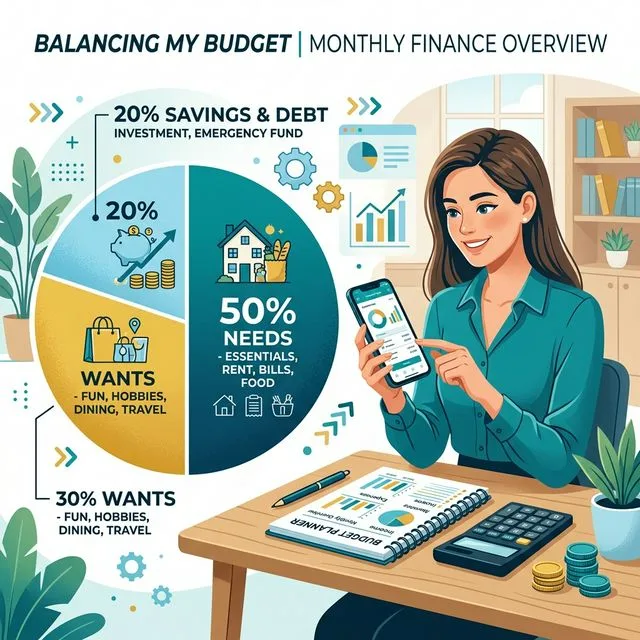
⚡ Key Takeaways
- 50% of take-home pay goes to needs (rent, food, utilities)
- 30% goes to wants (eating out, entertainment, hobbies)
- 20% goes to savings and debt repayment
- Use after-tax income, not gross salary
If you've tried complicated budgeting apps, color-coded spreadsheets, and elaborate tracking systems only to give up within a month, you're not alone. The 50/30/20 rule became popular for one reason: it's simple enough to actually stick with.
Created and popularized by Senator Elizabeth Warren in her book All Your Worth, the 50/30/20 rule provides a flexible framework that works for most income levels and life stages.
Breaking Down the 50/30/20 Rule
50% — Needs (Essentials)
Half of your take-home pay should cover your true necessities — things you absolutely cannot live without:
- Rent or mortgage payments
- Utilities (electricity, water, internet)
- Groceries (not restaurant meals)
- Transportation (car payment, insurance, gas, or public transit)
- Health insurance and minimum debt payments
- Childcare if required for work
If your needs exceed 50%, you either need to reduce expenses (find cheaper housing, cut your car payment) or increase income. This is a signal — not a judgment.
30% — Wants (Lifestyle)
This is the guilt-free spending category. Wants are things that make life enjoyable but aren't strictly necessary:
- Dining out and takeaway coffee
- Netflix, Spotify, and other subscriptions
- Clothes beyond bare necessities
- Gym memberships, hobbies, travel
- The "nicer" option when a cheaper one would do
"A budget isn't about cutting all your fun. It's about being intentional with your money so your spending reflects your actual values."
20% — Savings & Debt Repayment
This is where wealth is built. The 20% covers:
- Emergency fund — until you have 3-6 months of expenses saved
- Retirement contributions — 401(k), IRA, Roth IRA
- Investment accounts — index funds, ETFs
- Extra debt payments — above the minimum on credit cards, loans
- Other savings goals — house down payment, vacation fund
Real-World Example: $5,000 Monthly Take-Home
| Category | % of Income | Monthly Amount | Examples |
|---|---|---|---|
| Needs | 50% | $2,500 | $1,500 rent, $400 car, $400 food, $200 utilities |
| Wants | 30% | $1,500 | $300 dining, $200 subscriptions, $500 clothes/fun, $500 travel |
| Savings | 20% | $1,000 | $500 investments, $300 retirement, $200 extra debt payment |
Adapting the Rule to Your Situation
The 50/30/20 rule is a guideline, not a law. If you're in a high cost-of-living city, your needs might naturally be 60%. That's okay — you compensate by trimming wants to 20% and keeping savings at 20%. If you're aggressively paying off debt, flip 30% to savings and 20% to wants temporarily.
The power isn't in the exact percentages — it's in having a framework at all.
How to Start Today
- Calculate your monthly take-home pay (after taxes and deductions)
- List your current expenses and categorize them as Needs, Wants, or Savings
- Compare your actual percentages to 50/30/20
- Identify one or two adjustments to move toward the target
- Use our free Budget Planner to automate the calculation
CFA and personal finance expert with 15+ years of experience helping everyday people build wealth.