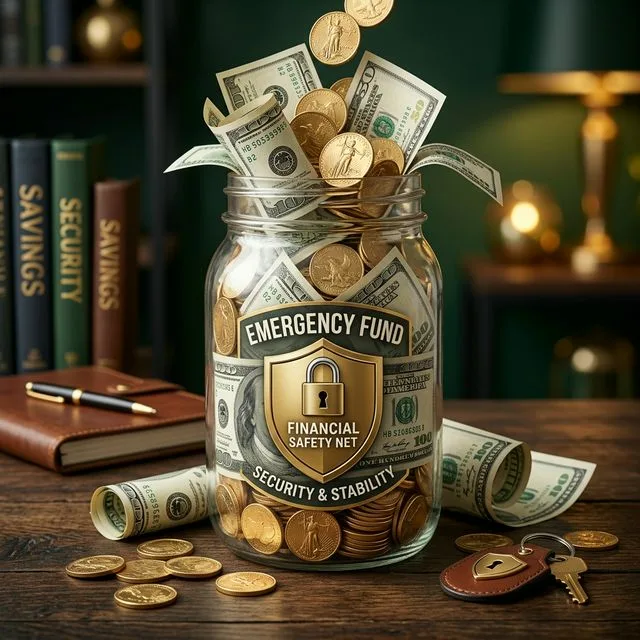
⚡ Key Takeaways
- An emergency fund should cover 3-6 months of essential expenses
- Keep it in a high-yield savings account (HYSA) — not invested in stocks
- Start with a $1,000 "starter fund" before working toward the full amount
- Treat your emergency fund contribution like a bill you pay yourself
Over 56% of Americans don't have enough savings to cover a $1,000 emergency. If an unexpected job loss, medical bill, or car repair hit tomorrow, most people would be forced to go into credit card debt or borrow from family. An emergency fund is the foundation that makes everything else in personal finance possible.
What Exactly Is an Emergency Fund?
An emergency fund is cash kept in a safe, accessible account — separate from your everyday checking — reserved exclusively for true financial emergencies:
- Job loss or reduction in income
- Unexpected medical expenses
- Major car or home repairs
- Emergency travel
It is NOT for planned expenses (vacations, Christmas gifts) or "it was on sale" impulse purchases. Those get their own savings buckets.
How Much Do You Actually Need?
Financial experts recommend 3-6 months of essential expenses (not income). Calculate your monthly essentials:
| Expense Category | Example Monthly Amount |
|---|---|
| Rent/Mortgage | $1,500 |
| Food/Groceries | $400 |
| Utilities | $200 |
| Transportation | $350 |
| Health insurance | $200 |
| Minimum debt payments | $300 |
| Total Monthly Essentials | $2,950 |
| 3-Month Fund Target | $8,850 |
| 6-Month Fund Target | $17,700 |
Phase 1: Build Your $1,000 Starter Fund
Before targeting 3-6 months, build a $1,000 buffer first. This handles most common emergencies and gives you psychological momentum. Here's how to get there fast:
- Sell unused items — eBay, Facebook Marketplace, or Craigslist. The average American has $500+ in unused items at home.
- Pause non-essential subscriptions for 90 days and redirect to savings.
- Take one freelance job or side shift this month — delivery, tutoring, or Fiverr work.
- Redirect your next bonus or tax refund entirely to the fund.
Phase 2: Build to 3-6 Months Systematically
Once you have your $1,000 buffer, shift to consistent monthly contributions. Automate them so you never have to think about it:
- Set up a dedicated high-yield savings account (HYSA) — earning 4-5% APY in 2026
- Set an automatic transfer on payday — even $200-300/month
- Direct any windfalls (bonuses, gifts, tax refunds) straight to the fund
- Temporarily pause extra investing until the fund is complete
Where to Keep Your Emergency Fund
The best place for an emergency fund in 2026 is a high-yield savings account (HYSA). Top options currently offer 3.8-4.2% APY:
- Marcus by Goldman Sachs
- Ally Bank
- SoFi Savings
- Discover Online Savings
Don't invest your emergency fund in stocks. Markets can drop 30-40% exactly when you need the money most. Liquidity beats returns here.
"The emergency fund is the financial equivalent of wearing a seatbelt. You hope you never need it — but you'd be insane to drive without one."
Emergency Fund Milestones
Track your progress to stay motivated:
- 🌱 $500 — You can handle a small emergency
- ✅ $1,000 — Starter fund complete
- 🛡️ 1 month — You have a real buffer
- ⭐ 3 months — Financial stability achieved
- 🏆 6 months — You're in the top 20% of Americans for financial preparedness
CFP who paid off $85,000 in debt in 3 years. James writes about budgeting, debt management, and building financial resilience.